Hi everyone
I've figured out how to change the settings on this 'ere Blogspot, so now anyone can leave a comment without having to have a google account or anything. So please feel free.
Any requests for topics?
:o)
Wednesday, January 26, 2011

Wednesday, January 19, 2011
To change or not to change...
As part of this job, my interpreter and I often visit young people with disabilities in their homes. I am often close to tears.
Even the worst situations I came across in Smethwick and West Bromwich seem like luxury compared to the lives of some of these people. 24 year-old Định didn’t mind me sharing his story…

Định's father left his mother as soon as they realised their son was disabled. Throughout his childhood and teenage years, Định stayed at home in the small hut, alone, while his mother worked in the fields to provide enough food for them both. Định's mother died four months ago. Now his aunt brings him food, and his cousins visit occasionally, but other than that his only human contact is in the evenings and mornings when his uncle comes to lift him on and off his bed. Định has severe pain in his hips and his neck. He was given a plastic wheelchair, but it broke a long time ago.
A wonderful NGO called Orphan Voice are now supporting him and his aunt and uncle with food packages, and I'm organising a new, stronger and more comfortable wheelchair for him through the organisation I am working with. But it's not much of a life, is it....
My point in giving this example, is that when we visited Định, neither my interpreter or the local volunteer who took us to see him were at all surprised or distressed at what they saw.
They don't see any particular problem in the way these young people have to live.
They don't see any particular problem in the way these young people have to live.
Here in rural Vietnam the difference between the lives of poor people with disabilities, and the lives of people who are just very poor is, sadly, not that huge. The people I work with see similar dirt, discomfort, barrenness, poverty and lack of opportunity in 'normal' fully-able-bodied homes. People here have, very recently, been through times of such hardship and suffering that their concept of a ‘decent’ standard of living is far far lower than my relatively-very-privileged UK standard.
My role here is to convince people of the benefits of doing some kind of creative therapy with young children with disabilities, and then to teach them how to do it.
But if people don’t see something as a problem over and above other problems, how can you convince them to work to change anything?
When it comes to the effectiveness of rehabilitation centers, lack of information is surprisingly rarely the problem. I’ve uncovered all sorts of useful booklets, advice sheets, CD’s and information packs (all in Vietnamese, often with pictures) from dusty cupboards. The staff and parents just don’t think to read or make use of it. They’ve attended numerous good training events, with financial incentives, days out, lunches and certificates, but for some reason they don’t apply what they've learnt. They say “thank you very much, that was very interesting and helpful”, and lose 95% of it on the motorbike home. It’s wasted.
WHY?
As I mentioned above, I think firstly people don’t have any motivation for change. A lack of physical ability is not the only barrier for these children. Even if we help a child to develop physical skills to the point that he/she can get around, they will most likely still not be able to attend school, or get a job to earn a living. The improvement to quality of life that I promote as a benefit of therapy are often not considered worth the thought and effort and time that the therapy requires. What we (in the UK) would consider an achievement is relatively meaningless for these families – “Wow, look! Jimmy lifted his hand up all by himself!!” is not something you’d ever hear here…. it's just not relevant.
What these families want, and need, is a child who can support them in their later years (there is no social security to speak of) – so understandably they will reserve the majority of their time, attention and money for an able-bodied sister or brother. (That’s if they have an able-bodied sibling… unfortunately some Dioxin/Agent Orange affected families don’t seem to realise that after 2 or 3 children born with disabilities, they should stop trying for an able-bodied child…)
What these families want, and need, is a child who can support them in their later years (there is no social security to speak of) – so understandably they will reserve the majority of their time, attention and money for an able-bodied sister or brother. (That’s if they have an able-bodied sibling… unfortunately some Dioxin/Agent Orange affected families don’t seem to realise that after 2 or 3 children born with disabilities, they should stop trying for an able-bodied child…)
Secondly, staff and families don’t have a lot of faith that ‘therapy’ works. It’s impossible to know whether a child develops better because of therapy, or whether they would have got there anyway. Whilst we can understand why it works, and demonstrate improvements, and explain benefits, we can’t prove, scientifically, that therapy works. It's almost impossible to get robust evidence, because it's inethical to withhold treatment if it can be offered. What makes it even more difficult to convince people is the fact that children can take years to do things. Changes are slow, and difficult to measure. And in addition, some kids with severe brain damage will never be able to do very much, no matter how much therapy we try invest in them.
So for these rural farming families, time and effort are far too precious to be risked on something that can’t be proven to work, and which won’t, at the end of the day, affect their disabled child’s inability to support them later on in life.
Quality of life is a luxury. Things will only ever change significantly for those with disabilities here when the area as a whole is lifted out of such grinding poverty. And this is out of the hands of the individual families and volunteers I am working with.
Still. I’m quite stubborn. I’ve come here to do a job and I won’t give up on potential. My ma used useful gardening terms to refer to the work we’re doing here – sowing seeds and drip-feeding. Gradually, slowly, consistently, planting and nurturing ideas. So I continue to promote movement and play and engagement with the children. I show by example, and explain to families and staff again and again, in different ways, the benefits of having children who are slightly more independent and happy. I try to make everything I teach easy to do at home, and try to use materials and items that they can get hold of very easily and cheaply. And I do believe it will have some impact, however tiny. And that's enough to keep working for.


I’m also going to produce a short storybook, telling the concurrent stories of two families in a village. Both families new-born babies with a brain injury (cerebral palsy). One family have no hope and no motivation, and do no therapy with their child. He lies on his back all day, and learns nothing. The other family decide they want to see what their child can learn, even though her body is awkward and abnormal. They try things. They make things using materials in the home and the market. They get advice. They go to the rehabilitation hospital.
The story will hopefully outline how one child has absolutely no chance to develop, and the other slowly but surely learns to do some things. It’s very difficult to write, because I need to be careful that parents don’t read it and think that if they do the same things as the fictional family, then their child will be able to do the things that the character learns to do (every child is different, every child needs different treatment). It’s the concept that I want to get across, not the specifics.
The story will hopefully outline how one child has absolutely no chance to develop, and the other slowly but surely learns to do some things. It’s very difficult to write, because I need to be careful that parents don’t read it and think that if they do the same things as the fictional family, then their child will be able to do the things that the character learns to do (every child is different, every child needs different treatment). It’s the concept that I want to get across, not the specifics.
I’d like to distribute this storybook to doctors, so that there’s a chance they might discuss the ideas with families when they diagnose disabilities in the first place (as opposed to “Sorry, we can’t do anything about it. Just take your child home.”) Ideally, they could give the families a copy. Other potential places to distribute would be therapy departments, child health nurses, and Government Red Cross departments….
But at the same time as I’m putting a lot of effort into this, I’ve still got a horrible feeling that in a year’s time, my booklet will be found nesting in dusty cupboards along with the rest of them….
Saturday, January 15, 2011
Why expensive equipment isn’t always the best thing…..
If you think about a day centre for kids with disabilities, you'll probably imagine rooms full of wheelchairs, mats, balls, parallel bars, frames, special seating, rolls, wedges…..
When disability centres are being established in developing countries, the initial focus is often on buying equipment. On filling the rooms with “things” to help the children.
Big deliveries arrive from the capital, paid for with foreign funds; shiny and brightly coloured and expensive and attractive.
This is completely understandable, and always done with positive intentions. But I’m going to suggest that putting all this ‘stuff’ into a poor rural day centre doesn’t actually help. In my opinion it causes a problem....
Parents start to bring their children to the centre for therapy. There’s a therapist, who (with varying levels of understanding and ability) uses the equipment for activities and games to help the children’s development. The parents watch and are happy. But this approach, whilst fun and beneficial for the child, encourages the parents to view ‘therapy’ as ‘what the child does with the therapist, using equipment, at the centre’. They are led to believe that therapy can only be done by someone with training and a ‘title’, using the expensive mats and rolls and wedges and seats from the city.
During the rainy season, or the harvest time, or a national holiday, or when it’s too cold, or too hot, or too misty, or the winds in the wrong direction… the family might only attend the centre once every three or four weeks. So if the child’s therapy is limited to what they do at the centre, they’ll only be engaged in activities to help their development for a few hours every three or four weeks. The rest of the time, during normal life at home, they will often just lie on their backs on the floor or on a hard bed.
In order for a child with a disability to develop to their potential, their parents need to become ‘therapists’. The parents need to understand that ‘therapy’ is a way of thinking. That therapy can, and should be, incorporated into absolutely everything a child does in daily life.
Therapy is the position a child sleeps in. The way you pick them up when they’re small. The way you don’t pick them up when they’re bigger. It’s the way you talk to them. The things you ask them to do for themselves instead of doing for them. It’s the pillow you tuck under their arms, or between their legs. It’s the direction you put them to lie on the day bed. The way you feed them, or help them to feed themselves. It’s the way you carry them, or don’t. The way they sit on the floor, or don’t. The things you encourage them to play with. The things you encourage, and the things you don’t let them do.
Parents (and families) need to adjust and commit to constantly thinking about how to make everyday life ‘therapeutic’ – or an opportunity for their child to learn new skills.
These families cannot afford big deliveries of shiny, expensive equipment for their homes. They’re certainly not going to get it for free from a National Health Service like families do in the UK. They have what’s available from the market. They have plastic stools and tables, available in one height only. They have blankets. They have bamboo mats. They have pillows. They have washing baskets. They have bowls and spoons. They have cardboard boxes and the packing inside them. If they splash out a bit and visit a bookshop they can get playing cards and crayons and colouring books. They have walls and windows and steps and bamboo growing outside.
My point is that therapy centres, and therapists, in poor rural areas of developing countries should focus on teaching families positions and activities that they can easily replicate at home, making creative use of things that are easily and locally available, rather than demostrating the use of expensive (and often imported) equipment from the cities. They need to think long-term. And local. And self-reliant, rather then dependent on outside funds, which are all-too-easily pulled.
If your aim is to provide top-quality therapy in your centre, then grab your catalogues and get ordering.
If your aim is to teach families how to bring out the potential in their child, then think about holding back. Hit the market instead.
If things from the market things break, as they do, they can be easily replaced, and life and therapy goes on….
If a child grows too big for a set of bamboo walking rails, then the family can cut some more bamboo and make a larger set.
If a child is using a home-made cardboard chair, and develops better sitting balance, the family can make a new chair that doesn’t have so much support.
If a childs needs more support in the wooden standing frame made by the carpenter in the village, then the family can take it back to the carpenter in the village and ask him to add some.
(Having said this, there are some pieces of equipment which are very important for the development of any child with more severe physical difficulties – specialist wheelchairs, plastic orthotics (splints) and walking aids for example - which should be made to measure and are best provided by people who know what they’re doing. I'm not about to start knitting walking frames....)
So my advice to organisations setting up rural therapy centres - think about your aims.
If your aim is to provide top-quality therapy in your centre, then grab your catalogues and get ordering.
If your aim is to teach families how to bring out the potential in their child, then think about holding back. Hit the market instead.
Monday, January 10, 2011
Cardboard chairs and the rainy season....
As you'll see from the post on 'cardboard chairs' - we were feeling proud of the made-to-measure chairs, and the kids were excited to start using them - so we finished them with a coating of tough coloured paper, and left it at that.
ERROR!!!
A couple of weeks later the rainy season hit - and I hadn't been prepared for quite how damp it would be. Constant rainfall - day and night, for weeks on end. The air was heavy with moisture, clothes never quite dried out, everything felt damp.
Dampness + cardboard chairs = a bit of a problem
They went soft and soggy, and started to go mouldy.
So as soon as we had a few days break from the rain, they had to go out in the sun to thoroughly dry out, before we properly finished them with spray paint and a couple of coats of varnish. Not ideal in terms of toxic chemicals, but the treatments have proved absolutely necessary, and I haven't seen any forms of seating available that aren't either made from plastic or covered in varnish.
ERROR!!!
A couple of weeks later the rainy season hit - and I hadn't been prepared for quite how damp it would be. Constant rainfall - day and night, for weeks on end. The air was heavy with moisture, clothes never quite dried out, everything felt damp.
Dampness + cardboard chairs = a bit of a problem
They went soft and soggy, and started to go mouldy.
So as soon as we had a few days break from the rain, they had to go out in the sun to thoroughly dry out, before we properly finished them with spray paint and a couple of coats of varnish. Not ideal in terms of toxic chemicals, but the treatments have proved absolutely necessary, and I haven't seen any forms of seating available that aren't either made from plastic or covered in varnish.
 |
Cô Sương demonstrating the chair she made for Hung. |
It seems to have done the trick.
So if you're trying something similar, anywhere in the world - be smarter than me and think about the seasons your chairs might need to weather....
(We're now playing about with polystyrene chairs, beanbags, packing boxes.... I'll update with pictures soon.)
Tuesday, January 4, 2011
Big Brother - maybe. Nanny state - definately NOT
I really like it that here in Vietnam, people are generally left to make their own decisions about whether or not something's dangerous. This is definately not a nanny state.
But being left to their own devices, people can do some really, REALLY risky things......
--------------------------------------------------------------
In the cities it's almost funny to watch glamorous fashionistas on the back of motorbikes holding their helmets in the air above their hairstyles, ready to put them down should they pass by a policeman. Or to see girls wearing helmets with big holes cut out to accomodate the sparkly hairclips.
Children here are apparently magically protected from injury... it's normal to see parents (in helmets) sitting solidly on the bike, whilst one, two, three children stand in the middle, no helmets....
On the highway it's not unusual to see motorbikes speeding along with passengers holding huge panes of glass sticking out sideways far far into the road... and thats just getting started on what can be attached to the back of motorbikes. So far I've seen a double wardrobe, a double mattress, an American style fridge, a bicycle, fully grown pigs, and now..... a coffin (I really really hope it was empty). Not all on one bike, obviously, but all quite incredible in their own rights. Both in terms of 'give it a go' optimism, danger level and astounding lack of concern for life.
I'm sure that the utility companies do have policies on health and safety, but I still hold my breath when I see dudes leaning ladders against the cables, climbing up and rooting around amongst the tangle, with motorbikes zipping around underneath.
Walking past a part-built house the other day I noticed that the builders using a technique for throwing bricks up onto the first floor using what looks like a long thin lacrosse stick. The bricks land exactly where the person on the first floor is busy doing the same thing up to the second floor. There must be an entire ward at the local hospital full of people with brick-shaped dents in their heads.
If a plug breaks, leaving only one pin, it's quite normal to see them jammed in sideways, sparking every time someone nudges the cable.
During a recent downpour, the caretaker for the centre was standing on a table, water pouring through the leaking roof, fixing the electric light. I couldn't look.
I'm sure these situations aren't limited to Vietnam, but it does seem that a lot of people here are very relaxed about the whole life/death thing. Maybe it's the Buddhist influence.... :o)
But being left to their own devices, people can do some really, REALLY risky things......
--------------------------------------------------------------
In the cities it's almost funny to watch glamorous fashionistas on the back of motorbikes holding their helmets in the air above their hairstyles, ready to put them down should they pass by a policeman. Or to see girls wearing helmets with big holes cut out to accomodate the sparkly hairclips.
Children here are apparently magically protected from injury... it's normal to see parents (in helmets) sitting solidly on the bike, whilst one, two, three children stand in the middle, no helmets....
On the highway it's not unusual to see motorbikes speeding along with passengers holding huge panes of glass sticking out sideways far far into the road... and thats just getting started on what can be attached to the back of motorbikes. So far I've seen a double wardrobe, a double mattress, an American style fridge, a bicycle, fully grown pigs, and now..... a coffin (I really really hope it was empty). Not all on one bike, obviously, but all quite incredible in their own rights. Both in terms of 'give it a go' optimism, danger level and astounding lack of concern for life.
I'm sure that the utility companies do have policies on health and safety, but I still hold my breath when I see dudes leaning ladders against the cables, climbing up and rooting around amongst the tangle, with motorbikes zipping around underneath.
Walking past a part-built house the other day I noticed that the builders using a technique for throwing bricks up onto the first floor using what looks like a long thin lacrosse stick. The bricks land exactly where the person on the first floor is busy doing the same thing up to the second floor. There must be an entire ward at the local hospital full of people with brick-shaped dents in their heads.
If a plug breaks, leaving only one pin, it's quite normal to see them jammed in sideways, sparking every time someone nudges the cable.
During a recent downpour, the caretaker for the centre was standing on a table, water pouring through the leaking roof, fixing the electric light. I couldn't look.
I'm sure these situations aren't limited to Vietnam, but it does seem that a lot of people here are very relaxed about the whole life/death thing. Maybe it's the Buddhist influence.... :o)
Thursday, December 30, 2010
3am noodles
Surprisingly this post isn't a story of late night revelry, which is the only situation you would normally find me talking about food at 3am...
10 months into my time in Vietnam, I think I've tried most foods you can get in this region. I'm so good at searching them out, that I've even started introducing local people to dishes that they didn't know they could get here.
I spoke before about breakfast, and the joy of a big bowl of noodles in the morning on the way to work. I've now settled into a rotation of two favourites.
One of these, Mỳ Quảng, was the 'love at first sight' which I spoke about in my first food post. This intense crush has remained, despite a temporary falling out when I ate 3 bowls, felt quite disgustingly full, and went off it for a few weeks. 'Mỳ Quảng' is extravagant, boisterous and demands attention. It's full of fun and if you're in the mood it can be exactly what you want. But at other times it's just... too much.
My other breakfast favourite has crept up on me slowly. It's quiet, understated and relatively unglamorous, but has proved to be reliable, consistant and comforting. 'Bún bò' is a simpler dish. Beef noodle soup. Less colour and pizazz than Mỳ Quảng. Less intense. Less complicated. But hot and filling and flavourful and good any time of day or night. It never lets you down.
Taking advantage of my time living here to eat plenty of both, last week I thought I should find out how they're made.....
Not content with looking it up online, I decided to go to the source. I normally eat at a small outdoor stall, 3 doors down from where I'm living. So one morning I asked the smiley lady (Cô Sáu), if I could go and cook with her the next day. Knowing that she starts serving at 6am, I was expecting a fairly early start, but I wasn't quite prepared for 3am! Still, if she can do it every day.... and I eat her noodles every day.... I should go....
The next morning I dragged myself out of bed, out the door, and up the street - where I stood looking suspicious under the streetlight. Thankfully the streets were deserted apart from a few rats running around, and they weren't going to try and pick me up or arrest me for prostitution.

At around 3.20am Mr Noodle (Chú Tấn) opened the grate at the front of their house, I said hello quietly, and he nearly had a heart attack. He was definately present when I asked her, but the 3am brain is a funny thing. I was very glad to see he gets up at that time too. Certainly by 6.30am when I go there to eat, he's reclining in a hammock while the missus works away. I was under the (mistaken) impression that he didn't do anything other than drink coffee.
At 4.30am a bag of bones arrives on a motorbike
At 5.00am a hunk of beef arrives on another motorbike, the sky begins to get light, the police start their physical training and the pagoda dong dude starts doing his darned donging.
At 5.30 a bundle of fresh noodles arrive on another motorbike, and people start passing by on their way to work.
At 5.45am I proudly serve the first customer a bowl of the finest 'My Quang'.....

He clearly finds it very very amusing to be served by a foreigner, but says it's delicious. I probably looked quite scary after waking at that ridiculous hour, and he felt at risk of a ladle over his head if he said anything different! I don't know how Mrs Noodles always looks fresh as a daisy, and is so incredibly cheerful.
By 8am I'm almost dribbling with tiredness, so after a nice bowl of noodles, I head home for a nap.....
The figures:
The breakfast stall is the only income for the family of 3 (children grown up and living else-where). They serve roughly 100 bowls of noodles, and provide about 40 takeaways. At 10,000 VND per bowl (that's about 30p) they'll take around 1,400,000 VND (£42) per day. The ingredients cost roughly 1,000,000 VND (£30) - leaving an income, between 3 people, of around £12 per day.
Not a lot, hey.
10 months into my time in Vietnam, I think I've tried most foods you can get in this region. I'm so good at searching them out, that I've even started introducing local people to dishes that they didn't know they could get here.
I spoke before about breakfast, and the joy of a big bowl of noodles in the morning on the way to work. I've now settled into a rotation of two favourites.
One of these, Mỳ Quảng, was the 'love at first sight' which I spoke about in my first food post. This intense crush has remained, despite a temporary falling out when I ate 3 bowls, felt quite disgustingly full, and went off it for a few weeks. 'Mỳ Quảng' is extravagant, boisterous and demands attention. It's full of fun and if you're in the mood it can be exactly what you want. But at other times it's just... too much.
My other breakfast favourite has crept up on me slowly. It's quiet, understated and relatively unglamorous, but has proved to be reliable, consistant and comforting. 'Bún bò' is a simpler dish. Beef noodle soup. Less colour and pizazz than Mỳ Quảng. Less intense. Less complicated. But hot and filling and flavourful and good any time of day or night. It never lets you down.
Taking advantage of my time living here to eat plenty of both, last week I thought I should find out how they're made.....
Not content with looking it up online, I decided to go to the source. I normally eat at a small outdoor stall, 3 doors down from where I'm living. So one morning I asked the smiley lady (Cô Sáu), if I could go and cook with her the next day. Knowing that she starts serving at 6am, I was expecting a fairly early start, but I wasn't quite prepared for 3am! Still, if she can do it every day.... and I eat her noodles every day.... I should go....
The next morning I dragged myself out of bed, out the door, and up the street - where I stood looking suspicious under the streetlight. Thankfully the streets were deserted apart from a few rats running around, and they weren't going to try and pick me up or arrest me for prostitution.

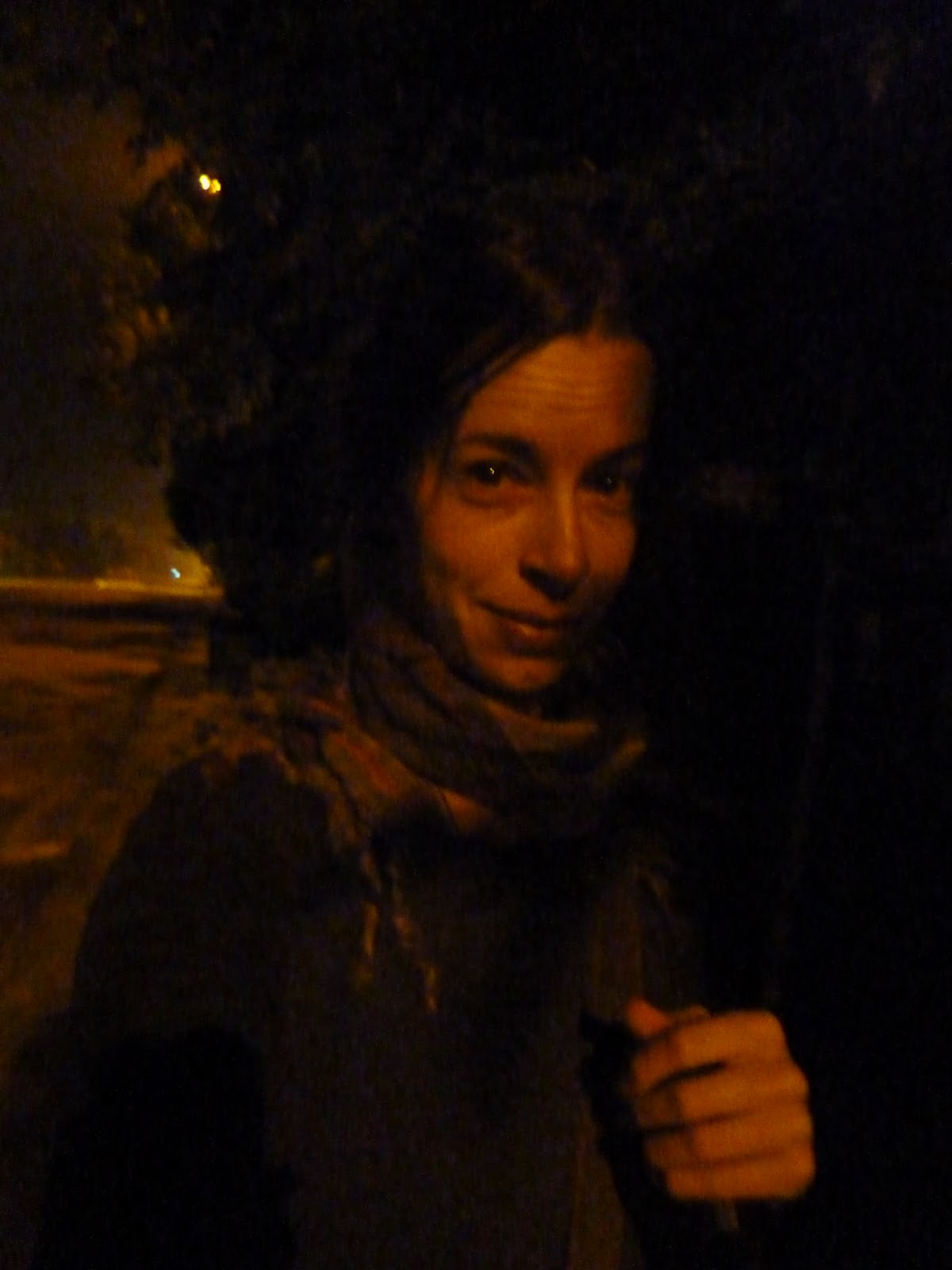
At around 3.20am Mr Noodle (Chú Tấn) opened the grate at the front of their house, I said hello quietly, and he nearly had a heart attack. He was definately present when I asked her, but the 3am brain is a funny thing. I was very glad to see he gets up at that time too. Certainly by 6.30am when I go there to eat, he's reclining in a hammock while the missus works away. I was under the (mistaken) impression that he didn't do anything other than drink coffee.
So by 3.30am there's Mr Noodles, Mrs Noodles, Grandma Noodles and me. Mr gets the fires going outside. Mrs and I wash a lot of salad leaves. Grandma carries tables and chairs and bowls and chopsticks, and sets up for service.
Lemongrass is tied and mashed, garlic and chilli are pestled, pineapple is cubed, tomatoes are pureed, pork and shrimps are marinated and fried and sliced, spring onions and chives are chopped, teeny tiny eggs are boiled, oil sizzles, knives fly... I feel quite in the way in the tiny kitchen. Clearly so does the mouse, which scarpers.
Lemongrass is tied and mashed, garlic and chilli are pestled, pineapple is cubed, tomatoes are pureed, pork and shrimps are marinated and fried and sliced, spring onions and chives are chopped, teeny tiny eggs are boiled, oil sizzles, knives fly... I feel quite in the way in the tiny kitchen. Clearly so does the mouse, which scarpers.
At 4.30am a bag of bones arrives on a motorbike
At 5.00am a hunk of beef arrives on another motorbike, the sky begins to get light, the police start their physical training and the pagoda dong dude starts doing his darned donging.
At 5.30 a bundle of fresh noodles arrive on another motorbike, and people start passing by on their way to work.
At 5.45am I proudly serve the first customer a bowl of the finest 'My Quang'.....

He clearly finds it very very amusing to be served by a foreigner, but says it's delicious. I probably looked quite scary after waking at that ridiculous hour, and he felt at risk of a ladle over his head if he said anything different! I don't know how Mrs Noodles always looks fresh as a daisy, and is so incredibly cheerful.
By 8am I'm almost dribbling with tiredness, so after a nice bowl of noodles, I head home for a nap.....
The figures:
The breakfast stall is the only income for the family of 3 (children grown up and living else-where). They serve roughly 100 bowls of noodles, and provide about 40 takeaways. At 10,000 VND per bowl (that's about 30p) they'll take around 1,400,000 VND (£42) per day. The ingredients cost roughly 1,000,000 VND (£30) - leaving an income, between 3 people, of around £12 per day.
Not a lot, hey.
Saturday, December 4, 2010
The Big Belief Buffet
In trying to understand and describe the various, co-existing and intermingling belief systems, religions, philosophies and traditional and modern influences here in Vietnam, the best analogy I can think to use is that of being at a big buffet. This post might seem to make light of what can be contentious subjects, but my intention is certainly not to disrespect what can be personal and deeply held beliefs. I respect that everyone has the right to make sense of life any way they want or need, in order to have peace with their actions and direction. This is just my way of trying to describe the complex, varied, and yet generally pragmatic mixture of beliefs here.
So please, open your minds.... and welcome to the Big Belief Buffet!
--------------------------------------------------------------------
I'd like you to imagine a beautiful room, with numerous tables laden with a wide range of dishes, to suit all tastes and appetites. It's generally very calm and peaceful and welcoming, and it appears that you're free to choose and mix anything you want.
But before you get busy fixing up a delicious meal, you'll be given a plate pre-served with some items. It'll be quite difficult to get any further without taking one. And you should be aware that the mirrors are two-way. The management operate a 'right of admission reserved' policy, and don't take kindly to 'trouble-makers'...
-------------------------------------------------------------------

Then you'll have some Confucianism - a very slow-cooked dish from China. For centuries these ancient teachings have influenced (and continue to influence) everything in Vietnam from national structure to community organisation, education and working life to family relations and social interactions. This complex dish is overall quite healthy. It's remarkably relevant and practical, with respect for your parents, elders and teachers, thankfulness and rememberance of your ancestors, dedication to education, and self-responsibility being some of the main ingredients. There is, however, a slightly bitter after-taste, which seems to suit men more than women; according to Confucious, men are ultimately superior to the fairer sex. This dish is distinctly more popular with the older generations, and some youth try to hide it under their chopsticks, regarding it as a bit old-fashioned.
Another of the 'compulsory' items on your plate will be a fair sized dollop of Communist policy, structure and conformism. You don't have to eat a whole plateful (only roughly 3% of the population are Party members) but it's definitely frowned upon to refuse it altogether.


And then it's unfortunate but unavoidable that you'll have a serving of nepotism gravy - covering everything from what job you can apply for (or have a chance of getting), who you can marry, where you can buy land....
--------------------------------------------------------------------------
OK, so now you can take your already pretty well-loaded plate and go explore the rest....
---------------------------------------------------------------------------
Optional items:
Guidelines
In general, you can take and mix whatever you like. Most people are busy fixing up and eating their own meals, and will let you get on with yours quite peacefully. If you find you have a favourite table and choose to stop there for the entire time, then you'll be generally be respected for it. Attendents check up on the behaviour at tables pretty regularly, but they're apparently becoming more easy-going than they have been in the past.
---------------------------------------------------------------------------
Now let me describe some of your extensive spiritual buffet options....
The majority of people will take some Buddhism;
Fancy visiting the beautiful and peaceful pagodas (very popular), maybe including prayers to statues of Buddha and other bodhisattvas, lighting incense sticks and taking offerings of food, drink and money?
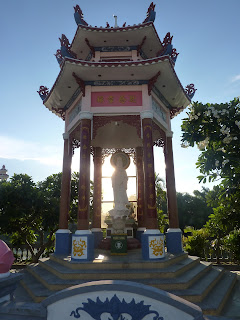

How about a statue or image of Buddha in your family alter, in the front of your bus, or on a necklace around your neck?
You'll happily help yourself to some belief in fate and quiet acceptance of life's trials.
You’ll most likely ignore the plates of meditation or yoga – they don't really suit the Vietnamese palate.
You might pick up some belief in re-incarnation, but unless you're a monk or nun it’s very unlikely to make you vegetarian or abstinent. The meat dishes and beer on the table are quite irrestistable….
You’ll definitely want some ancestor veneration / remembrance;
I heartily recommend the ‘Ancestor Party’ dishes – days of eating, drinking and remembering ancestors with the extended family. And spending the afternoon sleeping it off. They're great.
Remember, your parent's, grandparent's and great-grandparent's spirits live in the family alter alongside the God of the Home (it's like a tardis, don't worry, there's plenty of room), and they get pretty hungry, so pick up some extra fruit, sweets and drinks to replenish it when you get home. And don't forget to throw in some beers and cigarettes for grandad.

At the next table you might pick up some Christianity;
Catholicism is more popular than Protestantism, but both are available. If you're keen on it, you can go to Mass every Sunday. There are quite a lot of churches. Other people ignore this table completely. A lot of people just pick up some of the junk food - like the gaudy, sparkly, plastic, badly-sung and hip-hop Christmas items, which should, in my opinion, be banned altogether!

Small Islam and Hindu tables cater for some people from the Cham ethnic minority, but aren't of much interest to the general population.
A newly available, very popular and rapidly expanding area of this buffet is the Capitalism table; the rich foreign flavours proving very addictive for those who try it. Whilst some of the dishes are undeniably nutricious, some people say the flavours don't mix so well with the items already on the plate. And sometimes people find the dishes on this table so irresistable that they eat too much and get a bit sick.
And just next to the Capitalism dishes are the imported(?) Consumerism treats; very tempting, very easy to eat, and proving very popular, but the long-term health effects are questionable and the floor around the table is covered in discarded plastic wrappings.
The 'foreign flavours' table is completely surrounded by excited teenagers, and mostly ignored by older generations. Korean 'dishes' are particularly popular (fashion, movies, singers...) as is English football ("No, I'm not from Manchester... sorry, no, not Liverpool either...")
Condiments of ghosts, spirits and other superstitions can be found on most of the main tables - and can add significant flavour to your plate. Mediums and fortune tellers are on hand to advise you on selection.
Some people prefer to have their plates designed and made up for them.
 For them there is the option of the locally-produced Cao Đài platter - which appears to be a combination of most of the above (minus the capitalism, consumerism, meat and beer). Folks who order this seem to have an ethos of a great big hug - "all religions have one same divine origin, one same ethic based on love and justice, and are just different manifestations of one same truth", however some people find aspects of the platter a bit too unusual to be palatable.
So thats most of it. Quite a selection.
I'm sure I've missed, misunderstood or misrepresented some things, please don't hesitate to let me know...
....... karaoke!!

So please, open your minds.... and welcome to the Big Belief Buffet!
--------------------------------------------------------------------
I'd like you to imagine a beautiful room, with numerous tables laden with a wide range of dishes, to suit all tastes and appetites. It's generally very calm and peaceful and welcoming, and it appears that you're free to choose and mix anything you want.
But before you get busy fixing up a delicious meal, you'll be given a plate pre-served with some items. It'll be quite difficult to get any further without taking one. And you should be aware that the mirrors are two-way. The management operate a 'right of admission reserved' policy, and don't take kindly to 'trouble-makers'...
-------------------------------------------------------------------
Pre-served items:
To begin you'll have a large spoon of nationalism - a result of justified pride, censored media and extensive propoganda. (To be fair, when you've fought for numerous centuries to expel invaders, dealt with aggressive interferers, united yourselves and built a rapidly growing economy, I think you're intitled to feel a little bit pleased with yourselves.)
To accompany this you'll have a good sprinkling of love for 'Uncle Ho' (Hồ Chí Minh) on there. In fact his picture may well be on your plate. Mr Ho is revered and celebrated throughout Vietnam, for forming the Democratic Republic of Vietnam in 1945, and for being, at various times, Vietnam's motivator, activator, speaker, champion of the people, President, Prime Minister and until his death in 1969, military leader of the Viet Minh.
Then you'll have some Confucianism - a very slow-cooked dish from China. For centuries these ancient teachings have influenced (and continue to influence) everything in Vietnam from national structure to community organisation, education and working life to family relations and social interactions. This complex dish is overall quite healthy. It's remarkably relevant and practical, with respect for your parents, elders and teachers, thankfulness and rememberance of your ancestors, dedication to education, and self-responsibility being some of the main ingredients. There is, however, a slightly bitter after-taste, which seems to suit men more than women; according to Confucious, men are ultimately superior to the fairer sex. This dish is distinctly more popular with the older generations, and some youth try to hide it under their chopsticks, regarding it as a bit old-fashioned.
Another of the 'compulsory' items on your plate will be a fair sized dollop of Communist policy, structure and conformism. You don't have to eat a whole plateful (only roughly 3% of the population are Party members) but it's definitely frowned upon to refuse it altogether.
Then there'll be a few of the long-standing and enduringly popular folk dishes. These classics have evolved through centuries of rural, agricultural lifestyles - worship of plants, animals and fertility are integrated into most customs and practices of Vietnamese people.
According to everything I've read, you'll also have a bit of Daoism (or Taoism) - ancient recipes for living life, based on the concept of flow, or 'the way'. Kindness, simplicity and modesty are key (nicely demonstrated by shopping at the market with Vietnamese friends - sparkles, glamour and no holding back in telling you that you look ugly and fat!??) along with maintaining the balance between humanity and the cosmos (again - the lack of concern for the environment shown by most of the people I've met and worked with might bring the Tao influence here into question...) But still, I reckon it's a pretty nutricious dish, and we'd all do well to take a bit.
According to everything I've read, you'll also have a bit of Daoism (or Taoism) - ancient recipes for living life, based on the concept of flow, or 'the way'. Kindness, simplicity and modesty are key (nicely demonstrated by shopping at the market with Vietnamese friends - sparkles, glamour and no holding back in telling you that you look ugly and fat!??) along with maintaining the balance between humanity and the cosmos (again - the lack of concern for the environment shown by most of the people I've met and worked with might bring the Tao influence here into question...) But still, I reckon it's a pretty nutricious dish, and we'd all do well to take a bit.
And then it's unfortunate but unavoidable that you'll have a serving of nepotism gravy - covering everything from what job you can apply for (or have a chance of getting), who you can marry, where you can buy land....
--------------------------------------------------------------------------
OK, so now you can take your already pretty well-loaded plate and go explore the rest....
---------------------------------------------------------------------------
Optional items:
Guidelines
In general, you can take and mix whatever you like. Most people are busy fixing up and eating their own meals, and will let you get on with yours quite peacefully. If you find you have a favourite table and choose to stop there for the entire time, then you'll be generally be respected for it. Attendents check up on the behaviour at tables pretty regularly, but they're apparently becoming more easy-going than they have been in the past.
---------------------------------------------------------------------------
Now let me describe some of your extensive spiritual buffet options....
The majority of people will take some Buddhism;
Fancy visiting the beautiful and peaceful pagodas (very popular), maybe including prayers to statues of Buddha and other bodhisattvas, lighting incense sticks and taking offerings of food, drink and money?


How about a statue or image of Buddha in your family alter, in the front of your bus, or on a necklace around your neck?
You'll happily help yourself to some belief in fate and quiet acceptance of life's trials.
You’ll most likely ignore the plates of meditation or yoga – they don't really suit the Vietnamese palate.
You might pick up some belief in re-incarnation, but unless you're a monk or nun it’s very unlikely to make you vegetarian or abstinent. The meat dishes and beer on the table are quite irrestistable….
You’ll definitely want some ancestor veneration / remembrance;
I heartily recommend the ‘Ancestor Party’ dishes – days of eating, drinking and remembering ancestors with the extended family. And spending the afternoon sleeping it off. They're great.
Remember, your parent's, grandparent's and great-grandparent's spirits live in the family alter alongside the God of the Home (it's like a tardis, don't worry, there's plenty of room), and they get pretty hungry, so pick up some extra fruit, sweets and drinks to replenish it when you get home. And don't forget to throw in some beers and cigarettes for grandad.

At the next table you might pick up some Christianity;
Catholicism is more popular than Protestantism, but both are available. If you're keen on it, you can go to Mass every Sunday. There are quite a lot of churches. Other people ignore this table completely. A lot of people just pick up some of the junk food - like the gaudy, sparkly, plastic, badly-sung and hip-hop Christmas items, which should, in my opinion, be banned altogether!

Small Islam and Hindu tables cater for some people from the Cham ethnic minority, but aren't of much interest to the general population.
A newly available, very popular and rapidly expanding area of this buffet is the Capitalism table; the rich foreign flavours proving very addictive for those who try it. Whilst some of the dishes are undeniably nutricious, some people say the flavours don't mix so well with the items already on the plate. And sometimes people find the dishes on this table so irresistable that they eat too much and get a bit sick.
And just next to the Capitalism dishes are the imported(?) Consumerism treats; very tempting, very easy to eat, and proving very popular, but the long-term health effects are questionable and the floor around the table is covered in discarded plastic wrappings.
The 'foreign flavours' table is completely surrounded by excited teenagers, and mostly ignored by older generations. Korean 'dishes' are particularly popular (fashion, movies, singers...) as is English football ("No, I'm not from Manchester... sorry, no, not Liverpool either...")
Condiments of ghosts, spirits and other superstitions can be found on most of the main tables - and can add significant flavour to your plate. Mediums and fortune tellers are on hand to advise you on selection.
Some people prefer to have their plates designed and made up for them.
So thats most of it. Quite a selection.
I'm sure I've missed, misunderstood or misrepresented some things, please don't hesitate to let me know...
------------------------------------------------------------------------
After such a feast, desert is simple and very Vietnamese - some good humour....

humanity, pragmatism, astounding aesthetics and, of course.....
After such a feast, desert is simple and very Vietnamese - some good humour....

humanity, pragmatism, astounding aesthetics and, of course.....
....... karaoke!!

Subscribe to:
Posts (Atom)
